
Staff updates
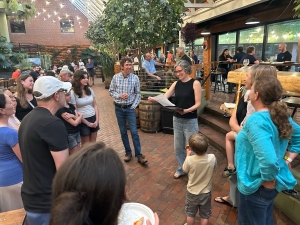
Colleagues gathered to bid Aimee farewell.
We are sad to announce that Aimee Weldon has left her role as the ACJV coordinator to begin a new position with The Trustees of Reservations in Massachusetts as the Vice President of their Ecology and Climate program. We are grateful for all that Aimee accomplished for the ACJV over the past 10 years. We miss her so much but look forward to working with her as a partner – good luck, Aimee! Until we can fill the ACJV Coordinator position with a permanent replacement, coordinator duties will be rotated within the existing ACJV staff. Mo Correll (maureen_correll@fws.gov) is currently acting as ACJV coordinator until the end of October, and will be followed by Craig Faulhaber (craig_faulhaber@fws.gov; beginning of November – end of January), and Pam Loring (pamela_loring@fws.gov; beginning of February – end of April). If the position is still vacant at that time, we will reassess how to temporarily fill the ACJV Coordinator duties. If you have any questions about this process, please reach out to Roya Mogadam (roya_mogadam@fws.gov).
Black Duck Impoundment Tool Update
The ACJV American Black Duck Working Group is seeking to compile a map of impoundments within the ACJV geography to help direct management actions. This spring, we launched a new Impoundment Mapping Tool to capture impoundment locations from partners. To date we have received data from partners on 1,885 waterfowl impoundments across the ACJV! Special thanks to partners from Maine, New Hampshire, Rhode Island, Connecticut, New York, Pennsylvania, Delaware, Maryland, and North Carolina for contributing data so far. We’re still seeking impoundment data from Vermont, Massachusetts, New Jersey, Virginia, South Carolina, Georgia, and Florida. We can accept most spatial formats or data submitted directly through the tool. Please send any remaining information by October 1 so that it can be included in a regional layer for public release this fall. Please feel free to reach out to Pam Loring (pamela_loring@fws.gov) with any questions. Thank you to all who have contributed!
Saltmarsh Sparrows and Restoration Document
The USFWS recently released Recommendations for Salt Marsh Restoration that May Impact Saltmarsh Sparrows: Maine to Virginia. This document is authored by the USFWS’s Saltmarsh Sparrow At-Risk Team (Mo Correll, Suzanne Paton, Aimee Weldon, Becky Longenecker, Sam Apgar, Bart Wilson, Kate O’Brien). This document is available on the USFWS’s ServCat as well as the ACJV website. It was developed to be a helpful resource for partners, with information about the natural history of the Saltmarsh Sparrow, potential risk to the species during salt marsh restoration, and opportunities to reduce risk during project design and implementation. It was collaboratively developed by a group of Saltmarsh Sparrow experts and honed by our Saltmarsh Sparrow At-Risk Team. USFWS biologists and salt marsh practitioners then reviewed and commented on the document before release. Thanks to all that contributed!
A USFWS at-risk species webinar about the contents of the document will be held Sept 15 from 10-11 am Eastern; please watch your email for an invitation!
Black Rail Management Priorities – Delaware and New Jersey Workshops
Over the last several years, the ACJV has been working with partners to identify priority marshes and priority site-specific management actions for both Saltmarsh Sparrows and Black Rails. With field seasons wrapping up, we are once again scheduling workshops with Delaware (Sep 11, 2-3pm Eastern) and New Jersey (Sep 14, 1-2pm Eastern) partners to identify Black Rail priorities. If you are interested in joining us, please contact Craig_Faulhaber@fws.gov. Prioritization efforts in additional states will follow over the next year.
North American Wetlands Conservation Act (NAWCA)
On 8/13/2026, the North American Wetlands Conservation Council recommended funding three out of seven projects submitted by ACJV partners for the second round of fiscal year 2026 Standard Grants. If these projects receive final approval by the Migratory Bird Conservation Council, they will conserve over 53,000 acres of habitat in Maine and North Carolina, and the $9M NAWCA investment will leverage over $20M in partner match. There is still time to submit proposals for wetland acquisition, restoration, or enhancement for the first round of fiscal year 2027 NAWCA Standard Grants (due September 25). You can find more information at Grants.gov by searching for Funding Opportunity Number F27AS00008, or you can visit https://www.grants.gov/search-results-detail/363306. Please reach out to Craig_Faulhaber@fws.gov or Pamela_Loring@fws.gov if you need assistance with proposal development.
Coastal Marsh Project Database
Our Coastal Marsh Project Database is up and running! Please visit our overview page to see if your restoration project is in the database, and if not, add an entry! Check out our how-to webinar for guidance in getting started in our database.